
From Raw Materials to Bags: Journey Through a Cement Plant

.png)
Table of Content
Ever wondered how the cement used in your home construction goes from raw materials to the final bag sitting at the store? Cement manufacturing is a fascinating process that combines science, engineering, and precision to turn natural materials into the strong building blocks of our homes.
In India, where construction is booming, cement plays a crucial role in every house, building, and infrastructure project. Let’s take a simple, step-by-step journey through a typical cement plant and see how this essential material is made.
1. Mining Raw Materials
The journey begins with the extraction of raw materials like limestone, clay, shale, and iron ore. These are typically mined from quarries using heavy machinery. Limestone is the primary raw material because it provides the calcium carbonate which is essential for cement production, while clay and shale supply the silica, alumina, and iron needed to form the cement’s chemical structure.
Once extracted, the raw materials are transported to the cement plant for processing.
2. Crushing and Grinding
After mining, the raw materials are crushed into smaller pieces to make them easier to handle. Large crushers break down the rocks into manageable chunks, and then they’re ground into a fine powder. This process ensures that the materials mix uniformly later in the process.
Grinding is critical because the finer the particles, the easier it is to combine them into a homogeneous mixture, which contributes to the quality of the final cement.
3. Raw Meal Preparation
The crushed and ground materials are carefully proportioned and blended to form what’s called a raw meal. This mixture is precisely measured to maintain the right chemical composition, typically consisting of calcium carbonate, silica, alumina, and iron oxide.
This step is crucial because any variation in the proportions can affect the strength and setting properties of the final cement.
4. Preheating and Calcination
The raw meal is fed into a preheater tower, where it is gradually heated using the exhaust gases from the kiln. This preheating process begins to remove moisture and partially decomposes the limestone.
Next comes calcination, where the heated raw meal enters a rotary kiln (a long cylindrical furnace that rotates slowly). The temperature inside the kiln can reach up to 1450°C. At these high temperatures, the raw materials chemically transform into a new substance called clinker.
During this intense process, limestone (CaCO₃) decomposes into lime (CaO) and carbon dioxide (CO₂), and the other components combine to form clinker minerals.
5. Cooling the Clinker
Once the clinker comes out of the kiln, it’s cooled down rapidly using air or water. Proper cooling is essential to lock in the crystalline structure of the clinker, which affects the strength and quality of the cement.
The cooled clinker appears as small, dark gray nodules, typically around 3–25 mm in size. These nodules are the core ingredient for the final cement product.
6. Grinding the Clinker
The cooled clinker is then mixed with small amounts of gypsum (usually around 5%) to control the setting time of the cement. This mixture is finely ground in a large cement mill until it turns into a powdery substance.
The fineness of this final grind determines the cement’s performance properties, such as setting time and strength development. The goal is a uniform, fine powder that can easily mix with water and aggregates during construction.
7. Quality Control and Packaging
Throughout the entire process, strict quality control tests are performed. Samples are taken regularly to check chemical composition, fineness, and strength properties. These tests ensure that every bag of cement meets industry standards and will perform reliably in construction.
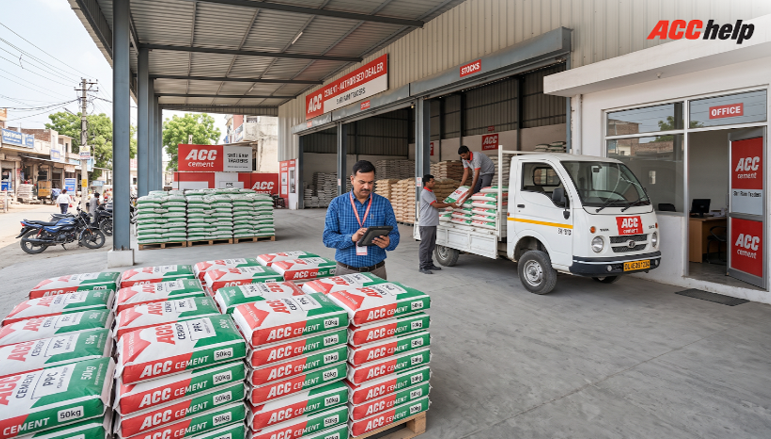
Once the cement passes the quality checks, it’s packed into bags of various sizes, typically 50 kg, or stored in bulk silos for dispatch. The packaged cement is now ready to be delivered to stores, construction sites, or directly to customers.
8. Ready for Construction
From mining limestone in quarries to the final bag of ACC cement, every step in the process is designed to create a product that’s strong, durable, and reliable. The journey involves precise control of material proportions, temperature, grinding fineness, and quality testing so that the cement stands up to the demands of Indian weather and construction needs.
Final Takeaway
Understanding how cement is manufactured in a cement plant helps us appreciate the science and effort behind every bag of OPC and PPC cement. The process from raw materials to the finished cement bag involves crushing, mixing, heating, cooling, and grinding all under strict quality control of ACC Cement’s experts.
Whether you’re building your dream home or working on a big construction project, knowing this journey gives you confidence in the materials you choose. After all, strong homes start with strong cement.
Next time you see a bag of ACC cement at your local store, you’ll know the full story of how it came to be there ready to support your home for years to come.