


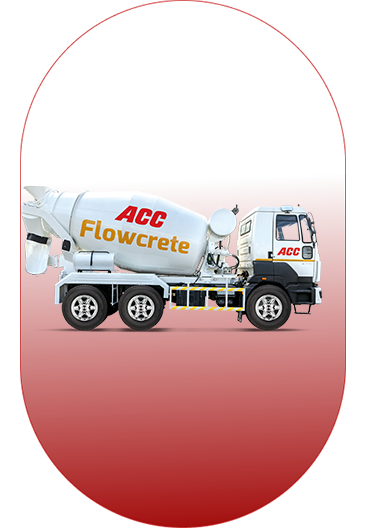
ACC Flowcrete
Self‑Compacting Concrete. Fast, Vibration‑Free Placement
Features

Features
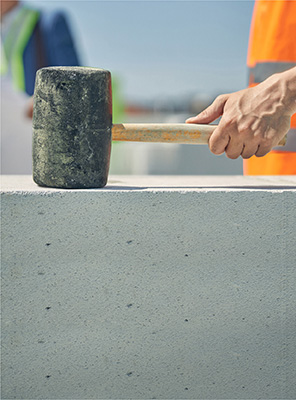
Easy Placement
High flowability makes the placement of concrete easier and speeds up casting. This light weight concrete works great for tricky spaces and fast work.
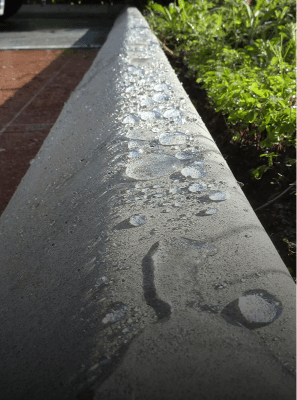
Smooth Finishing
Reduces labour costs by removing the need for vibrations and gives a smooth surface finish. A smart ACC concrete choice for projects that need a high-quality surface finish.
Increased Durability
It compacts on its own, making the concrete stronger and longer lasting. ACC Flowcrete is a trusted ready mixed concrete solution for durable construction.
Areas of Application
Can be used in piers in bridge construction with dense reinforcement and high falling height of concrete.
Due to the high-flow nature of the product, it passes through congested reinforcement and reduces honeycombing in sections.
Its unique properties make it an ideal choice for tunnel backfilling as it solves a variety of challenges.







Frequently Asked Questions
Slow or fast setting normally depends on the nature of the cement. It could also be due to extraneous factors not related to the cement. The ambient conditions play an important role. In hot weather, the setting is faster, in cold weather, the setting is delayed. Some types of salts, chemicals, clay, etc. if inadvertently mixed with sand, aggregate and water could accelerate or delay the setting of concrete.
Cement is a hygroscopic material meaning that it absorbs moisture. In the presence of moisture, it undergoes a chemical reaction termed hydration. Therefore, cement remains in good condition as long as it does not come in contact with moisture. If cement is more than three months old, then it should be tested for its strength before being taken into use.
Fineness defines the surface area of cement particles present per unit weight, which implies that more fineness means more particles in unit weight. This enhances the reaction rate, which in turn will result in a faster gain of strength at earlier stages.
Pozzolana combines with lime and alkalis in the cement and when water is mixed forms compounds that contribute to strength, impermeability, and sulphate resistance It also contributes to workability, reduces bleeding and controls destructive expansion from the alkali-aggregate reaction. The leaching of free lime is also reduced.
No. The quality of cement depends upon the raw materials used and the quality control measures adopted during its manufacture, and not on the shade of the cement. The cement gets its colour from the nature and colour of raw materials used, which will be different from factory to factory, and may even differ in the different batches of cement produced in a factory. Further, the colour of the finished concrete is affected also by the colour of the aggregates, and to a lesser extent by the colour of the cement. Preference for any cement based on colour alone is technically misplaced.
Cement which is in the form of a fine powder tends to absorb moisture present in the atmosphere. When it absorbs moisture it hydrates, and when subsequently used does not contribute to the strength development. Jute bags (gunny bags) in which cement is stored are neither airtight nor damp-proof and do not prevent the absorption of moisture. Cement deteriorates in quality on long storage.
Cement bags in woven polythene bags or paper bags are not likely to deteriorate to the extent mentioned above. The loss of strength also depends on the condition of the storage space. It is advisable to use cement within three months of its bagging or to test the cement for its strength if stored for longer periods. Hence, cement bought first should be used first.
Precautions that must be taken in the storage of Portland cement are given below:
(i) Do not store bags in a building or a godown in which the walls, roof and floor are not completely weatherproof.
(ii) Do not store bags in a new warehouse until the interior has thoroughly dried out.
(iii) Make sure the doors and windows of the space fit properly and are kept shut.
(iv) Do not stack bags against the wall. Similarly, don’t pile them on the floor unless it is a dry concrete floor. If not, bags should be stacked on wooden planks or sleepers.
(v) Do not forget to pile the bags close together.
(vi) Do not pile more than 15 bags high and arrange the bags in a header-and-stretcher fashion.
(vii) Do not disturb the stored cement until it is to be taken out for use.
(viii) Do not take out bags from one tier only. Step back two or three tiers.
(ix) The principle of first-in first-out should be followed in removing bags. Do not keep dead storage.
(x) Do not stack bags on the ground for temporary storage at the work site. Pile them on a raised, dry platform and cover them with a tarpaulin or polythene sheet.

Lalit & Reshma
Rajendra & Shailja Gupta
Rajesh & Sunita Mehta
Rina Kapoor
Sunil Grover


